
For two decades, the marketing résumé ran on an honor system. A line reading “Bachelor of Science in Advertising” or “five years managing paid media” was a claim a hiring manager either trusted or didn’t, and verification rarely went deeper than a reference call and a gut read. In high-data performance environments, that honor system has quietly collapsed. When a single misconfigured attribution window, a misread incrementality test, or a sloppy bid-strategy migration can burn six figures of client budget over a weekend, “trust the résumé” stops being a viable screening protocol. Growth marketing firms in 2026 are increasingly screening for something the legacy résumé was never built to carry: independently verifiable evidence that a candidate can actually perform the quantitative work the role demands.
The macro pressure behind that shift is well documented. The World Economic Forum’s Future of Jobs Report 2025 found that 63% of employers name skills gaps as the primary barrier to business transformation. ManpowerGroup’s talent shortage research puts the share of employers who struggle to find the skills they need above 70%. And Accredible’s 2025 State of Credentialing Report reports that 86% of employers say they’d be more likely to interview a candidate holding a digital credential that proves a specific skill. For performance agencies competing over a thin pool of people who can genuinely engineer paid media, the question is no longer whether to weight verified skill over pedigree. It’s how to build a screening pipeline around it.
How skills-mapped degrees work, and why they rewrite agency vetting
A traditional marketing degree is defined by content areas and credit hours. The transcript that results lists course titles and grades, and that’s the problem from a vetting standpoint. A line reading “Marketing Analytics, B+” tells a performance director almost nothing operationally useful. It doesn’t reveal whether the candidate can build a media mix model, configure GA4 conversion events without polluting the data layer, write a SQL query against a warehouse, or design a clean geo holdout test. The credential certifies exposure to a subject. It does not certify a demonstrated, current ability.
A skills-mapped degree inverts that logic. Every course is built around specific, identified competencies, and those competencies are derived from labor market analysis (active job postings, occupational data, industry advisory input) rather than only from academic tradition. Students demonstrate each mapped skill through assessment, and in the strongest implementations, they earn portable digital badges or microcredentials at the course level, as skills are proven, not only at graduation. The output is no longer a single diploma delivered years later. It’s an accumulating sequence of verifiable, shareable evidence tied to discrete competencies.
For an agency’s vetting process, that changes the fundamental unit of evaluation. Screening shifts from the credential (does this person hold a marketing degree?) to the competency (can this person demonstrate verified proficiency in multi-touch attribution analysis?). A skills-mapped record lets a hiring manager parse capabilities rather than infer them from a degree title and a graduation year. In a sector where the relevant tooling turns over every eighteen months, that distinction is decisive. A four-year-old advertising degree may describe a media landscape that no longer exists, while a course-level badge earned six months ago against a defined assessment standard describes a capability the candidate can prove today.
Which universities issue digital badges with degrees, and how verified skill data automates sourcing
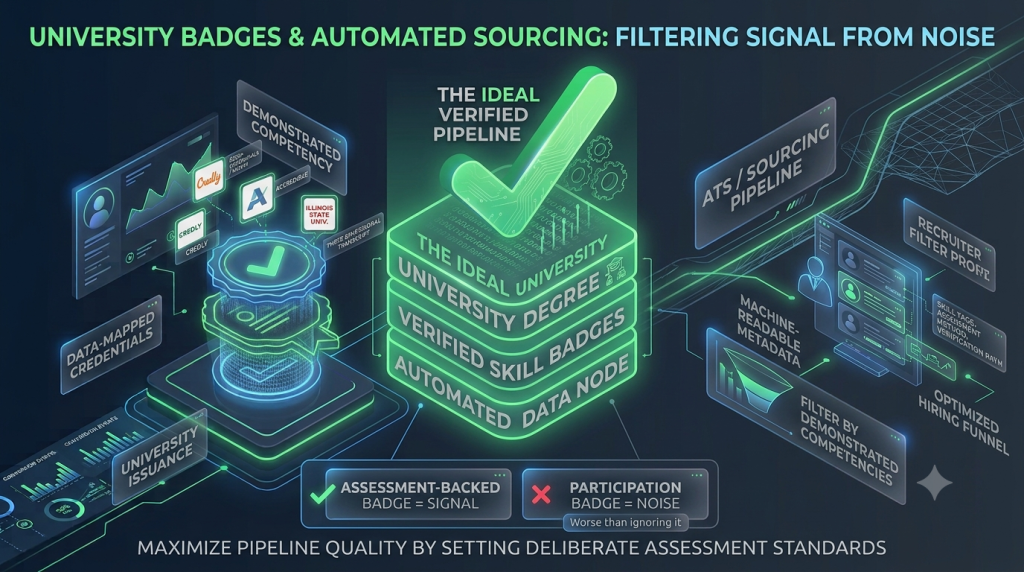
Badge issuance alongside degrees is no longer experimental. A large and growing set of institutions now layer verifiable credentials onto traditional programs, typically through Open Badge platforms like Credly and Accredible. Credly alone reports that more than 650,000 credentials are shared from its network every month, spanning universities, certification bodies, and corporate academies. Illinois State University was an early adopter that used badges as a kind of “three-dimensional transcript” to capture honors-program skills a diploma couldn’t express. Among for-profit and working-adult-focused institutions, the directional signal is clear: badge-augmented degrees have moved from pilot to scale.
The mechanism that matters to talent sourcing is the metadata. A modern digital badge is not a decorative image. It’s a machine-readable data object, structured under the Open Badges standard, carrying the skill that was assessed, how it was evaluated, the issuing institution, the issue date, and a verification path. That structure is what turns a credential into what a sourcing pipeline can treat as a verified data node. Applicant tracking systems and sourcing tools can parse skill tags directly. A recruiter can run skill-based Boolean searches rather than keyword-matching on degree titles. Verification resolves without a phone call to a registrar. In practice, this lets a performance agency filter inbound applicants by demonstrated competencies (say, candidates with assessed credentials in paid social optimization and SQL) and surface qualified people the résumé-keyword approach would have buried.
The caveat belongs in the same breath as the capability, because performance professionals will demand it. A badge is only as credible as the assessment behind it. A participation or completion badge that certifies attendance is noise in a sourcing pipeline, and treating it as signal is worse than ignoring it. The competency-aligned, assessment-backed badge, ideally one whose metadata names the assessment criteria and the proficiency threshold, is the artifact worth filtering on. Automation amplifies whatever quality standard the agency sets, so the standard has to be set deliberately.
CBE versus skills-mapped curriculum: two different problems they solve
Performance leaders evaluating where talent is trained should not conflate competency-based education with skills-mapped curriculum. They answer different questions.
Competency-based education (CBE) is fundamentally about pacing and mastery. In a CBE program, students progress by demonstrating mastery of competencies rather than by accumulating seat time, and they advance as soon as they pass the required assessments. Western Governors University, the largest CBE institution in the United States with well over 180,000 students, pioneered the model at scale: there are no traditional letter grades in the usual sense, only demonstrated competence against a standard. The structural promise is that the credential measures learning, not time, which is why CBE suits self-directed adults who can accelerate through material they already command.
A skills-mapped curriculum is a different lever. It governs what gets measured and whether the result is externally verifiable, not how fast a student moves. A skills-mapped program defines its courses by labor-market-derived competencies and produces portable, independently confirmable evidence of each one. Those two ideas can coexist (a program can be both competency-based in its pacing and skills-mapped in its design), but they are not the same thing, and a program can implement one without the other.
For data analytics and paid-media engineering specifically, the distinction has practical weight. CBE’s mastery-based pacing benefits the experienced practitioner who can test out of foundational statistics and spend time only on what’s genuinely new, such as marketing mix modeling or causal incrementality methods. Skills-mapped design is what ensures the measured competencies track the current stack rather than an academic abstraction: GA4 and server-side tagging, SQL and warehouse querying, Python for analysis, experiment design, bid-strategy logic, and platform-specific engineering. There is also a definitional nuance practitioners should keep straight. A skill is a discrete, demonstrable ability. A competency is broader, bundling knowledge, application, and judgment. The strongest programs for this sector combine mastery-based pacing with skills-mapped, badge-verified outcomes, so a graduate leaves with both accelerated progress and provable, granular capabilities.
The best programs for working professionals: quantitative depth plus real-time verification
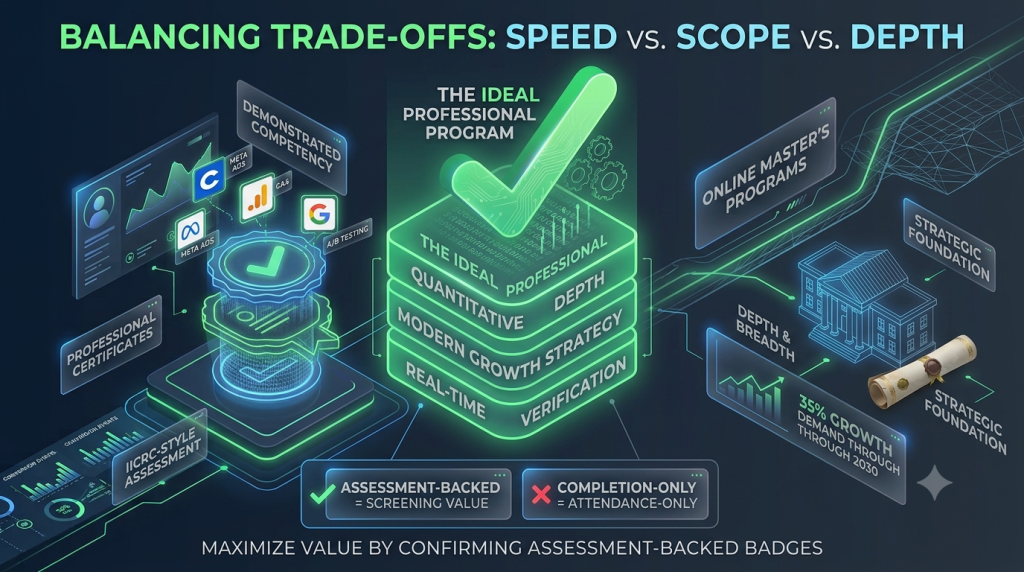
The ideal program for a working performance marketer satisfies two requirements at once: it builds genuine quantitative capability, and it produces verifiable evidence of that capability in real time, before a multi-year degree is complete. Few options check both boxes perfectly, so the realistic approach is to evaluate the tradeoffs.
Professional certificates are the fastest route to verifiable, stackable skill evidence. Industry programs delivered through platforms like Coursera in marketing analytics issue credentials with explicit skill tags (Meta Ads Manager, Google Analytics, A/B testing, conversion funnel analysis, data visualization, and Python’s pandas, among others), and many are assessment-backed and shareable on completion. The tradeoff is scope: a certificate proves a focused competency, not the broad analytical foundation an enterprise growth role often wants. Platform-native credentials such as Google Skillshop and Meta Blueprint certifications, occupy similar territory, validating tool-specific paid-media engineering ability with industry recognition but narrow breadth.
Online master’s programs supply the depth that certificates lack. Quantitatively oriented options, including analytics-focused marketing master’s programs, build the statistical and modeling foundation that separates a campaign operator from a growth strategist. The labor market rewards that depth: the U.S. Bureau of Labor Statistics projects roughly 10% employment growth for advertising, promotions, and marketing managers, and independent program analyses cite demand for analytics master’s graduates growing about 35% through 2030. The tradeoff is verification cadence: a traditional master’s still delivers most of its proof at the end.
The combination worth seeking closes that gap. A quantitatively rigorous program that also issues course-level, assessment-backed badges lets a working professional prove specific competencies as they’re earned, which is exactly the evidence a current employer or a prospective agency can act on mid-program. CBE-structured institutions oriented toward working adults, including WGU, Southern New Hampshire University, and Purdue Global, increasingly pair mastery-based progression with badge issuance, approximating that ideal. Two cautions apply regardless of format. Confirm institutional and programmatic accreditation, and confirm that the credentials are assessment-backed rather than completion-only. A badge that certifies attendance carries none of the screening value of one that certifies a passed, defined assessment.
A metrics-driven vetting framework for performance agencies
The shift from pedigree to proof only pays off if an agency operationalizes it. A defensible 2026 screening framework rests on five principles.
First, screen for assessment-backed credentials, not participation. Inspect badge metadata for the assessment criteria and the proficiency threshold, and discard anything that merely certifies enrollment or attendance.
Second, prefer credentials built on open, verifiable standards. A credential that validates independently through its own embedded proof is auditable and portable. One that resolves only through a vendor’s hosted page inherits that vendor’s uptime as a single point of failure.
Third, map credentials to the actual stack the role uses. Translate the job’s real requirements (GA4, BigQuery, Looker, SQL, Python, experiment design, marketing mix modeling, and the relevant platform certifications) into the specific competencies the screen should filter on, rather than accepting a generic “marketing analytics” label at face value.
Fourth, pair the credential with a practical work sample. Verified credentials are a high-quality way to narrow the funnel, but a short paid exercise (auditing a messy account, debugging an attribution setup, or interpreting an ambiguous test result) confirms applied judgment that no badge fully captures.
Fifth, treat all self-reported and vendor-supplied data as directional. Institution-reported badge counts, platform engagement statistics, and credentialing-industry surveys frequently originate from parties with a commercial interest in the result. They’re useful as signal, not as audited proof, and a rigorous agency validates independently before weighting them.
From pedigree to proof
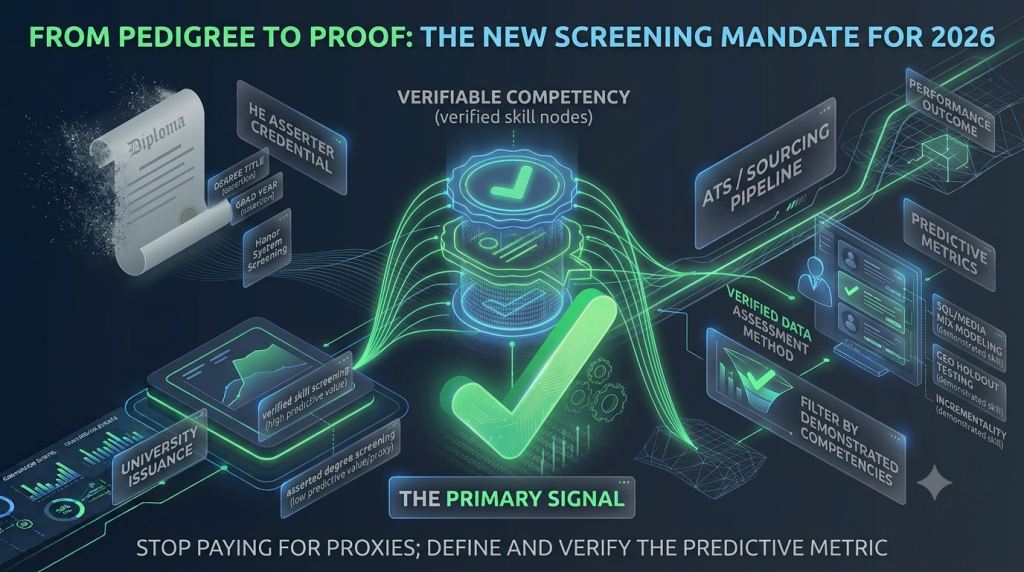
The résumé will persist as a narrative document, and the marketing degree will retain real value as a foundation. What’s changing in 2026 is the location of the load-bearing screening signal. In high-data performance environments, that signal is migrating from the asserted credential to the verifiable competency, expressed as machine-readable, independently confirmable skill data. Agencies that rebuild their sourcing and vetting pipelines around verified skill nodes, while holding a firm line on assessment rigor, will systematically out-hire competitors still parsing degree titles and graduation years. The discipline required is familiar to anyone who runs performance media for a living: define the metric that actually predicts the outcome, verify it independently, and stop paying for proxies that don’t.
Supplemental Reading
Credentialing Standards and Verification
- org/standards/open-badges: the Open Badges specification governing verifiable, machine-readable credential metadata
Labor Market and Skills Data
- gov/ooh: occupational outlook and employment projections for marketing roles
Competency-Based and Skills-Mapped Learning
- edu/about/story/cbe: an overview of the competency-based education model at scale
- com/advice/best-online-analytics-degree-masters-programs-for-working-professionals: comparative analysis of online analytics programs for working adults